Fingerprinting Stealth LLMs With Differential BPE Token Math

While wiring OpenCode's free inference tier into my local 9router gateway, I ran into six mystery model IDs sitting next to the normal ones: beam-free, exo-free, space-bunny-free, cat-jam-free, big-pickle, and ll-alpha-free. I wanted to know which one was actually smart enough to trust with a coding session, and which lab trained each one.
My first instinct was to just ask them. That failed in about ten seconds. When you ask exo-free which model family it belongs to, it confidently tells you "Claude (Anthropic)" because of synthetic distillation data in its post-training mix. When you asked cat-jam-free yesterday, its hidden system prompt told it to say "You are CatJam, an AI model developed by LitterBox AI." When you ask space-bunny-free, it says its runtime only identifies it as "Space Bunny" and refuses to guess its base model. A model can lie in its text output because the provider controls the system prompt and the training mix. What the provider cannot easily fake is the BPE tokenizer running on the inference server, or the raw SSE envelope that wraps each chunk.
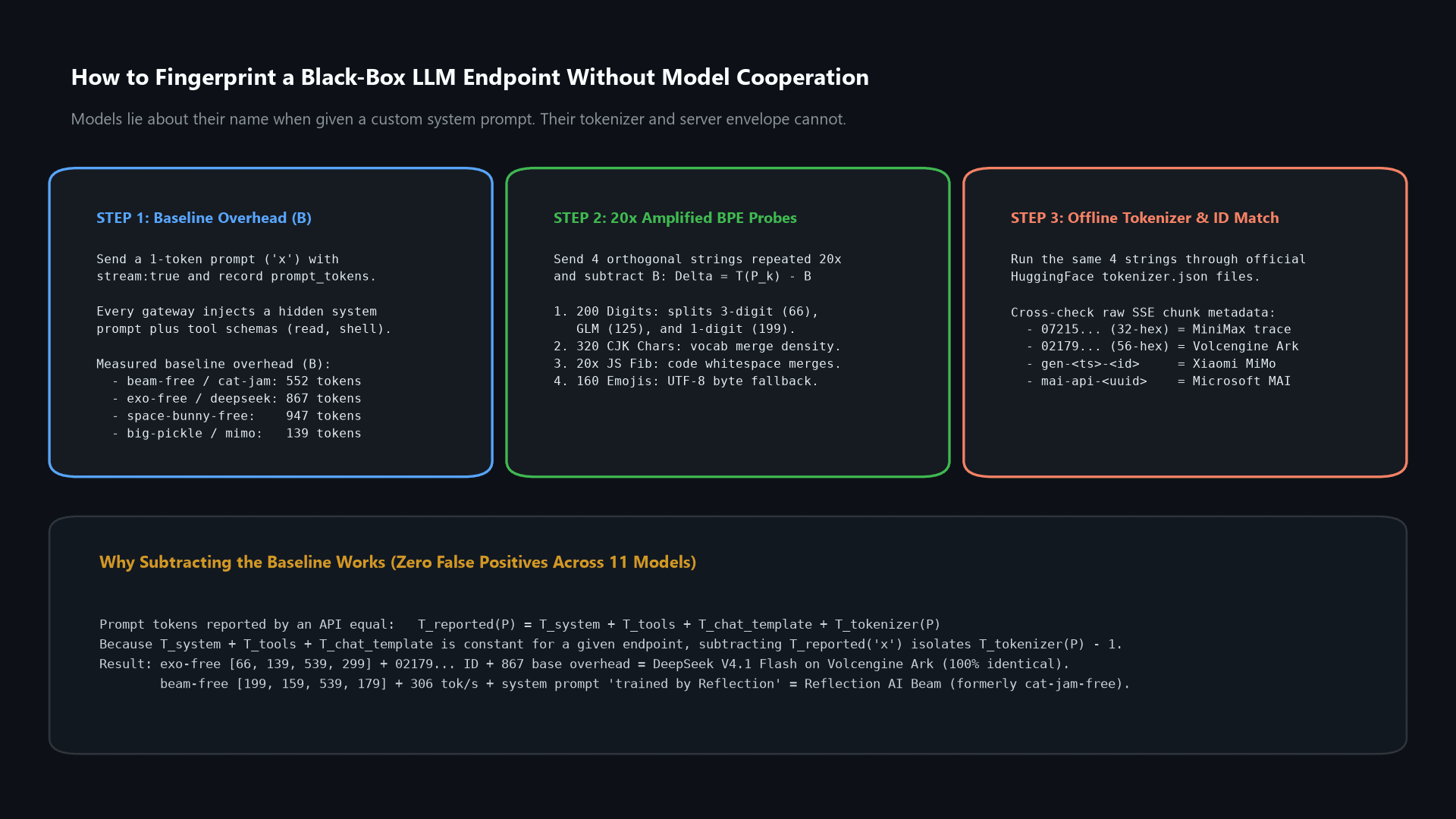
Every OpenAI-compatible chat endpoint returns usage.prompt_tokens at the end of a stream. That number includes your user message, the chat template tokens, any injected tool schemas, and the hidden system prompt. You cannot compare raw prompt_tokens across endpoints because space-bunny-free has 947 tokens of system and tool overhead while beam-free has 552.
The fix is differential probing. First, send a one-character baseline message ("x") and record its prompt_tokens as B. Next, send a test string repeated 20 times and subtract B. Repeating the probe 20 times turns even a 1-token vocabulary difference into a 20-token gap, while the unknown system prompt and tool schemas cancel out completely.
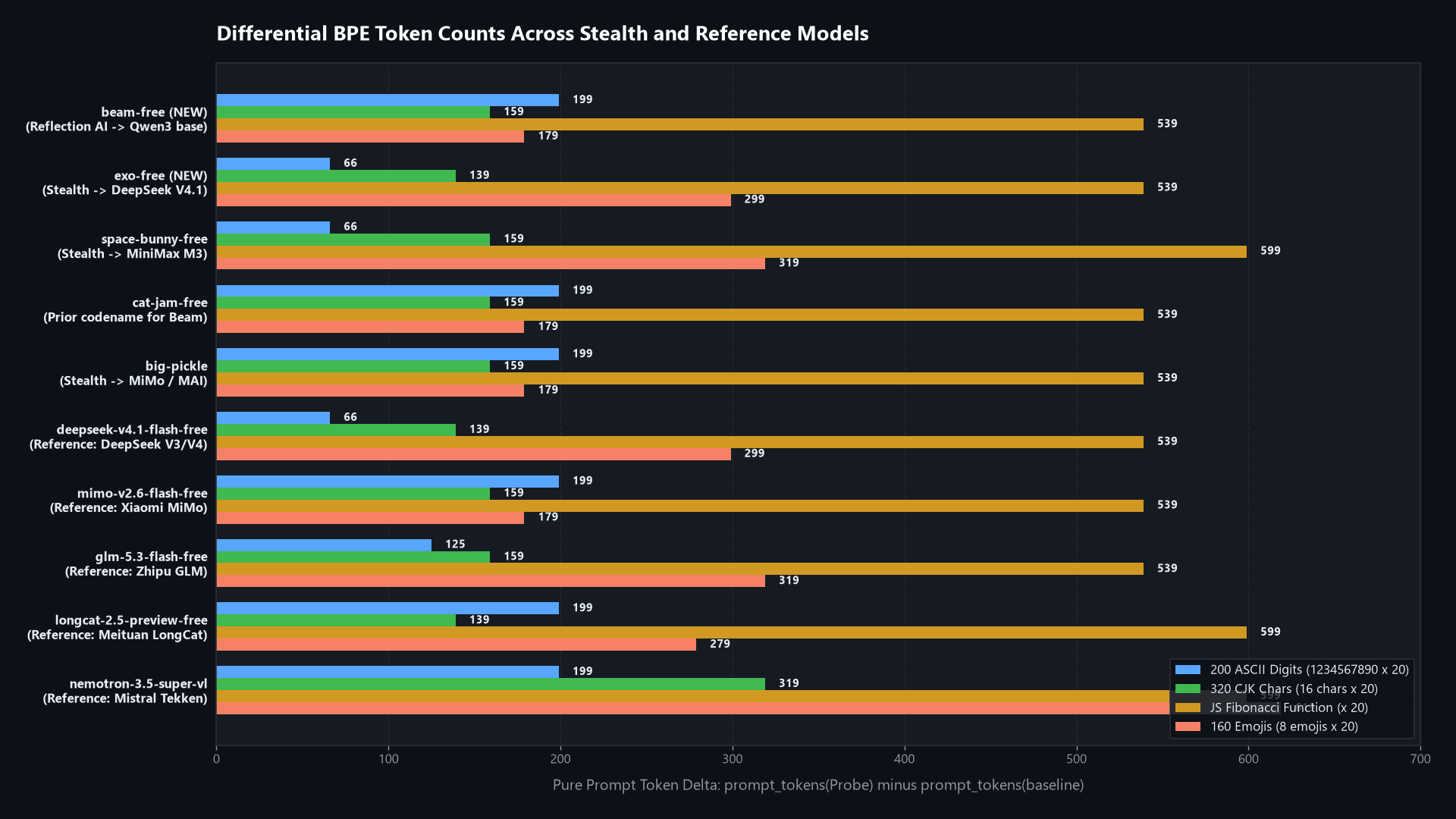
I picked four probes that pull apart modern LLM tokenizers along independent axes. First, 200 ASCII digits ("1234567890" repeated 20 times): tokenizers built on cl100k/o200k, DeepSeek, and MiniMax group numbers into 3-digit chunks (delta = 66). Zhipu GLM uses mixed 1-to-2 digit merges (delta = 125, unique to GLM). Qwen, Xiaomi MiMo, LongCat, and Mistral Tekken split every single digit into its own token (delta = 199). Second, 320 Chinese characters (16 common AI terms repeated 20 times) to measure CJK merge density: DeepSeek and LongCat compress this to 139 tokens, Qwen/MiMo/GLM/MiniMax take 159, o200k takes 199, and Mistral Tekken takes 319. Third, a recursive JavaScript Fibonacci function repeated 20 times (539 vs 599 tokens). Fourth, 160 multi-byte emojis to test UTF-8 byte-fallback splitting (179 in Qwen/MiMo, 279 in LongCat, 299 in DeepSeek, 319 in MiniMax/GLM, 359 in o200k, 619 in Tekken).
Once I had the 4-number delta vector [Digits, CJK, Code, Emoji] from each live endpoint, I wrote a 30-line Python script using HuggingFace's tokenizers library to run the exact same four strings through the official tokenizer.json files for Qwen2.5/Qwen3, DeepSeek-V3, MiniMax-Text-01, GLM-4, Xiaomi-MiMo, Meituan LongCat, and Mistral-Nemo (Tekken). Every single one matched to the exact token.
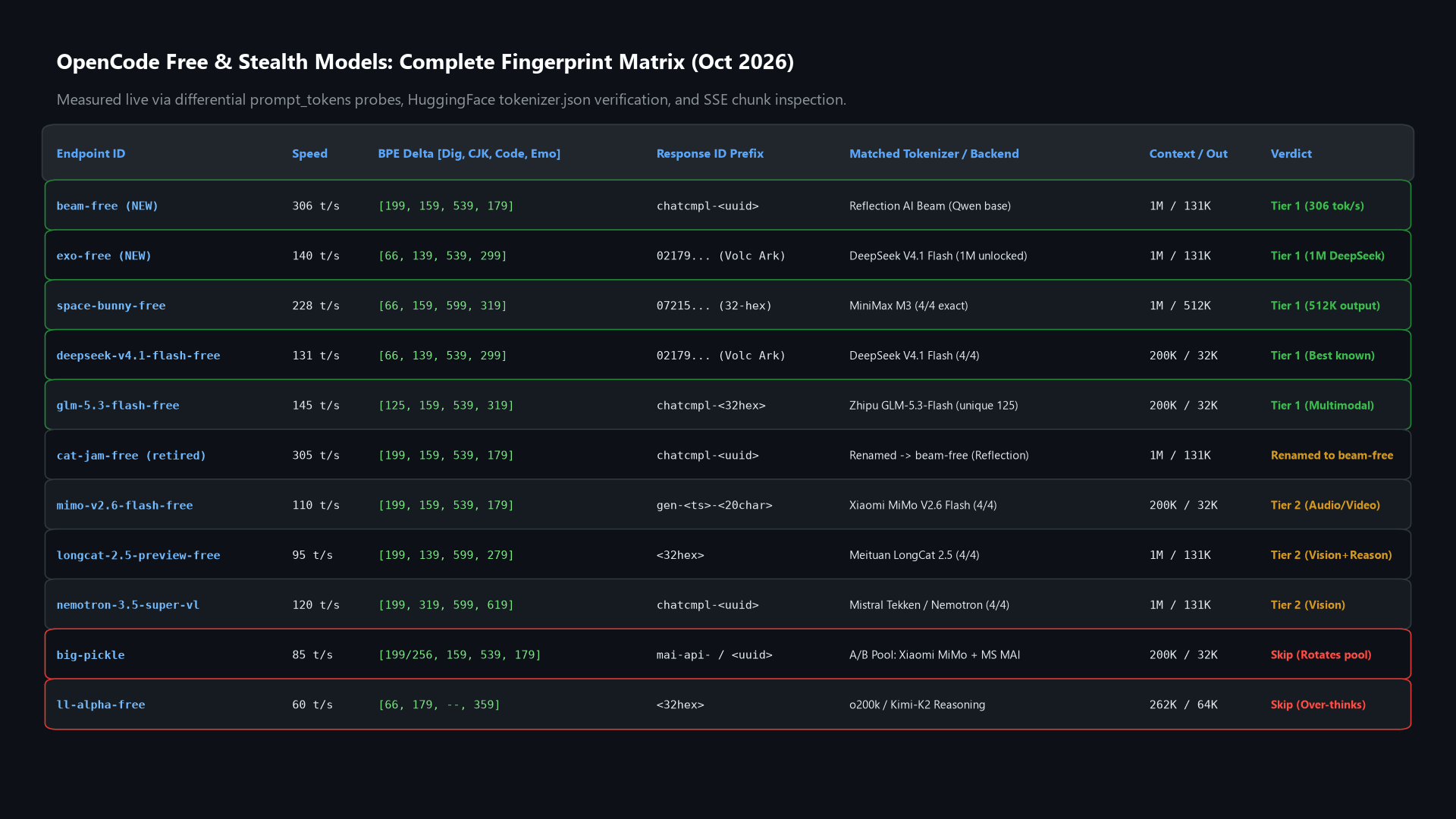
beam-free (which replaced cat-jam-free in the live catalog today) returned [199, 159, 539, 179], matching the 151,936-vocab Qwen2.5/Qwen3 tokenizer 4 for 4. Inside its reasoning_content stream, it leaked its new system prompt verbatim: "You are Beam, an AI assistant trained by Reflection." Comparing its telemetry against yesterday's cat-jam-free run confirmed they are the exact same model and cluster: both have a 552-token base overhead, 64-token block KV caching, a vLLM chatcmpl-<uuid> server screaming along at 306 tokens/sec, and the same telegraphic chain-of-thought grammar ("We need answer user. Need write 6-line Python function..."). Reflection AI tested their Qwen-based reasoning model under the LitterBox AI / CatJam alias before unmasking it as Beam.
exo-free returned [66, 139, 539, 299], a 4 for 4 match to deepseek-ai/DeepSeek-V3, even though its chat output claimed it was Claude. On a 700-token dynamic-programming benchmark, exo-free and deepseek-v4.1-flash-free reported the exact same prompt_tokens (867), the exact same cached_tokens (768), the same ~135 tokens/sec generation speed, and the exact same 56-character Volcengine Ark trace ID prefix (02179...). The difference is the catalog cap: deepseek-v4.1-flash-free is throttled to 200K context and 32K output in the public metadata, while exo-free still exposes the full 1M context and 131K output window.
space-bunny-free came back with [66, 159, 599, 319], which matched MiniMaxAI/MiniMax-Text-01 [66, 159, 599, 319] across all four probes without a single token of drift. Its raw SSE chunks also carry 32-character hex IDs starting with 07215..., which is the exact trace ID format returned by api.minimax.chat. Combined with its catalog limits (1M context, 512K max output, vision and video input, 228 tokens/sec), space-bunny-free is MiniMax M3.
big-pickle turned out to be an A/B router pool rather than a single model. On my first probe, its SSE chunk ID came back as mai-api-347e4440... (Microsoft AI's internal prefix). On the next probe, its ID switched to <uuid>_<32hex>, its BPE vector hit [199, 159, 539, 179] with a 139-token baseline (identical to mimo-v2.6-flash-free), and its internal reasoning trace started with: "1. I'm MiMo, developed by Xiaomi's LLM Core Team." ll-alpha-free matched the o200k / Kimi-K2 family on digits (66) and emojis (359), and spent all 1,500 completion tokens inside its reasoning block before emitting a single character of final text. If you route coding agents through OpenCode's free tier, put exo-free (1M DeepSeek V4.1 Flash), space-bunny-free (512K MiniMax M3), and beam-free (306 tok/s Reflection AI Beam) at the top of your fallback chain.